
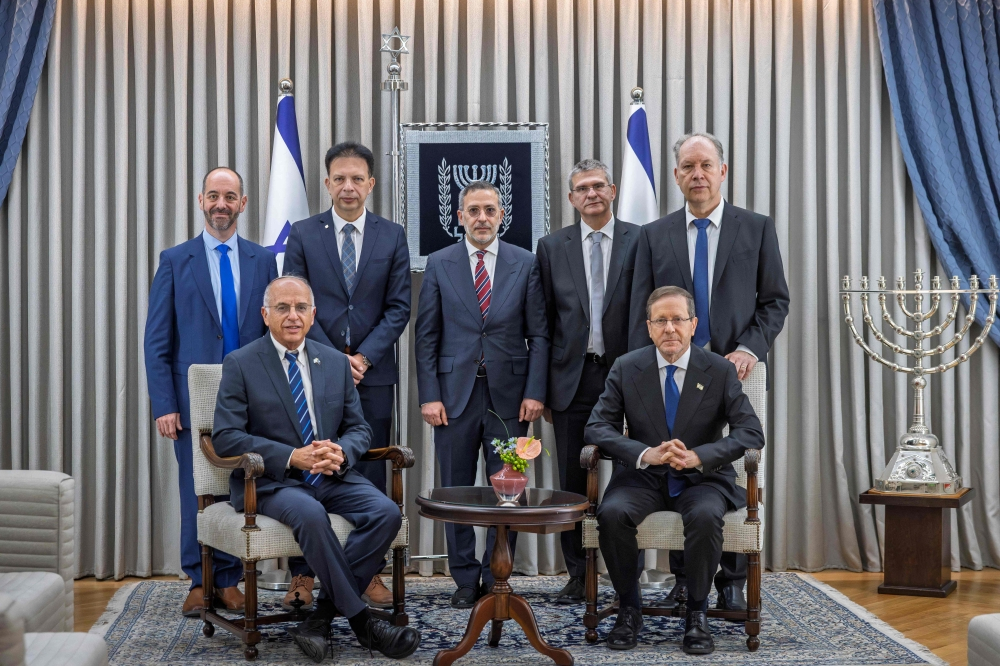
Israel has entered another critical political moment after President Isaac Herzog announced that opposition leader Gadi Eisenkot would receive the first opportunity to form the country’s next government. The decision follows the October 27 election, which ended without either political bloc securing the majority needed to govern, creating a fresh challenge for Prime Minister Benjamin Netanyahu and his long-standing political leadership.
Eisenkot, a former military chief who has entered politics with a message aimed at attracting secular and liberal voters, now has an opportunity to bring together a diverse group of political parties. His potential coalition could include ultra-Orthodox Jewish representatives, an alliance that once appeared unlikely but may now become essential to securing enough parliamentary support.
According to Herzog’s office, the formal appointment will take place during a ceremony at the president’s residence in Jerusalem on Sunday. Eisenkot received recommendations from parties representing 67 lawmakers, compared with 46 lawmakers supporting Netanyahu’s bloc. However, the numbers do not automatically guarantee a government, as disagreements within the opposition could make coalition negotiations difficult.
One of the biggest challenges facing Eisenkot is the question of cooperation with Israel’s Arab political representatives. Their increased parliamentary presence following the election reflects growing dissatisfaction among parts of the Arab minority with Netanyahu’s leadership. However, some right-leaning opposition parties remain uncomfortable with depending on Arab lawmakers to establish a governing coalition.
The possibility of a national unity government
President Herzog has indicated that he would like to explore the possibility of a national unity government, bringing together Jewish political representatives from different sides of the political spectrum. Such an arrangement could offer a way out of the country’s political divisions, particularly as Israel continues to face security challenges and the consequences of prolonged regional conflict.
Netanyahu has also called for a unity government, but opposition leaders have maintained that his departure from power must come first. The disagreement has become a central obstacle in negotiations, with both camps presenting different visions for Israel’s political future.
Netanyahu, who has dominated Israeli politics for much of the past two decades, faces significant personal and political challenges. He is dealing with corruption charges that could carry serious consequences if he leaves office. He also faces an arrest warrant issued by the International Criminal Court over the Gaza war, an accusation he rejects along with the court’s authority.
The possibility of renewed military action against Iran could further complicate political negotiations. Netanyahu has previously threatened to resume the conflict, although US President Donald Trump has not given approval for such a move. Any escalation could increase pressure on political leaders to establish a stable government.
Political divisions over Arab representation
Netanyahu has strongly criticised opposition figures for considering cooperation with Israeli Arab parties. On Saturday, he described a potential coalition involving opposition groups and Arab political lists as a threat to Israel’s national identity and stability. He called instead for a unity government involving what he described as Zionist parties committed to protecting the country.
Eisenkot’s Yashar party responded by encouraging members of Netanyahu’s Likud party and other political allies to break away from what it called an alliance with extremist elements. The party argued that a national unity government should be established under Eisenkot’s leadership.
In his first public response after receiving the mandate, Eisenkot called for an emergency government and pledged to make every effort to bring the necessary political support together.
However, even within the opposition, differences remain significant. Avigdor Liberman, a former Netanyahu ally who later became one of his strongest critics, has indicated that he would not join an Eisenkot-led government if it depended on support from Israeli Arab lawmakers.
Ultra-Orthodox military exemptions become a key issue
Another major development concerns the long-running debate over military service exemptions for ultra-Orthodox Jewish men.
For years, the issue has created tension between religious communities and other sections of Israeli society. The debate has become particularly sensitive as military reservists continue to face repeated deployments connected to the conflicts in Gaza and Lebanon.
Liberman and opposition leader Naftali Bennett had previously made ending the exemption a central part of their election campaigns. Both had criticised the existing arrangement, arguing that military responsibilities should be shared more equally across society.
However, Liberman recently signalled that he was open to discussions about legislation that could preserve exemptions for ultra-Orthodox men, marking a notable shift in his position.
Eisenkot has proposed a different approach, suggesting that all Israeli citizens should undertake national service while allowing individuals to choose between military service and civilian alternatives. The proposal could potentially create a compromise that brings ultra-Orthodox representatives into a broader political arrangement.
Before receiving the mandate, Eisenkot had described replacing Netanyahu as an urgent national priority, arguing that the current leadership posed a threat to the foundations of Israeli democracy.
What happens next for Israel?
Eisenkot now has 28 days to secure the support of at least 61 lawmakers in the 120-member Knesset, Israel’s parliament, to establish a government. If he cannot achieve that within the initial period, President Herzog may grant an additional 14 days.
If Eisenkot fails, the mandate could be offered to another political leader. Should all attempts to form a government collapse, Israel may be forced into another election.
The country has already experienced repeated political deadlocks, holding five elections between 2019 and 2022 before political stability remained elusive.
For Israeli citizens, the coming weeks will be about more than choosing between political leaders. The negotiations will test whether parties with deeply different positions can find common ground on national security, military responsibilities, religious exemptions, minority representation and the future direction of the country.
Eisenkot’s appointment represents an important opportunity for Netanyahu’s opponents, but removing a long-serving prime minister and building a government capable of surviving political disagreements are two very different challenges. Whether this moment produces a new political beginning or another election will depend on the compromises Israel’s political leaders are willing to make.
Source: Agence France-Presse (AFP).


