
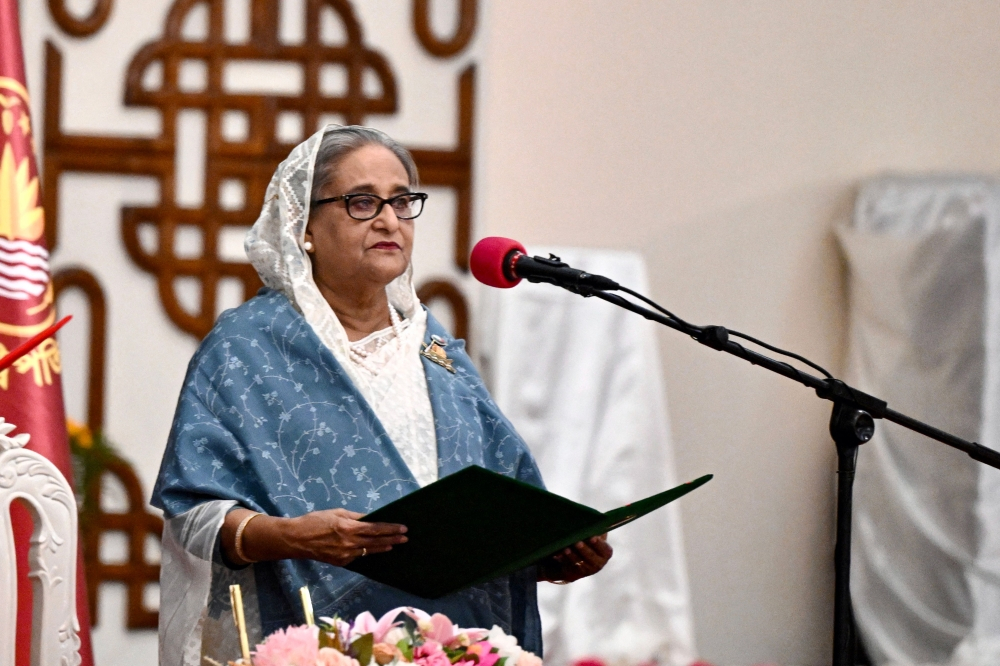
Bangladesh’s political crisis has taken another dramatic turn after a prosecutor involved in the case against former Prime Minister Sheikh Hasina said she would face execution if she returned to the country.
Hasina, whose 15-year rule ended following a massive student-led uprising in 2024, remains in India after fleeing Bangladesh amid growing public anger over the government’s crackdown on protesters. She was later convicted in absentia of crimes against humanity linked to the violence that followed the uprising.
Speaking to reporters, Bangladeshi prosecutor Md Aminul Islam said Hasina had no remaining legal option to challenge the verdict, claiming that the statutory deadline for filing an appeal had expired.
“Sheikh Hasina has no option but to face the execution of the verdict,” Islam said, responding to reports that the former leader intended to return to Bangladesh in December.
The 79-year-old former prime minister has repeatedly expressed her intention to return, despite knowing the potential consequences. In an earlier interview with AFP, she acknowledged that she could face execution but maintained that fear should not determine her responsibility towards the people of Bangladesh.
From political leadership to a historic downfall
Sheikh Hasina, the daughter of Sheikh Mujibur Rahman, who led Bangladesh towards independence in 1971, played a significant role in shaping the country’s modern political and economic landscape.
During her 15 years in power, Bangladesh experienced substantial economic expansion, developing from an agriculture-dependent economy into an important global manufacturing centre. The country also strengthened its position in the international garment and textile industries.
However, her administration faced growing criticism over allegations of political repression, restrictions on press freedom, the imprisonment of political opponents and widespread human rights violations.
The situation reached a breaking point in 2024 when student-led demonstrations developed into a nationwide uprising against her government.
According to the United Nations, as many as 1,400 people were killed during the crackdown on protesters. As public anger intensified, Hasina fled Bangladesh by helicopter in August 2024, eventually seeking refuge in neighbouring India.
She has remained there since her departure, largely staying away from public appearances and occasionally addressing media conferences by telephone.
Death sentence delivered in absentia
In November 2025, a court in Dhaka sentenced Hasina to death in absentia after finding her guilty on three counts of crimes against humanity.
The charges included incitement, ordering killings and failing to prevent atrocities during the government’s response to the 2024 uprising.
Hasina had refused to return to Bangladesh to participate in the trial, which examined whether she held command responsibility for the violent suppression of protesters.
The proceedings included testimony from witnesses who described the devastating consequences of the crackdown, including one individual who suffered severe facial injuries from gunfire.
Represented by a state-appointed lawyer, Hasina dismissed the proceedings as a “jurisprudential joke” and continued to challenge the legitimacy of the trial.
The prosecutor now maintains that the appeal period has expired, leaving her without the opportunity to challenge the conviction through the ordinary statutory appeal process.
Extradition request puts India under pressure
Bangladesh has formally approached India to seek Hasina’s extradition under the existing extradition treaty between the two neighbouring countries.
India has confirmed that the request is undergoing legal review. However, Hasina’s continued presence on Indian soil has become a sensitive diplomatic issue, adding pressure to an already complicated relationship between Dhaka and New Delhi.
Prosecutor Islam has advised Hasina to approach Indian authorities directly if she genuinely intends to return to Bangladesh through the extradition process.
Her legal situation could become even more complicated as she faces several other cases, including corruption-related allegations.
Meanwhile, her lawyers have reportedly requested the renewal of her passport, although they have not disclosed her intended travel arrangements. Islam also suggested that passport authorities could refuse to issue a passport to someone convicted of serious crimes.
Hasina’s possible return raises political concerns
Hasina’s repeated promise to return in December presents a significant challenge for the government led by Prime Minister Tarique Rahman.
Bangladesh remains deeply divided over her political legacy and the events that brought her government to an end.
While some sections of the population are demanding that the death sentence be carried out, others fear that her return could reignite political tensions, strengthen the position of her former supporters and create another confrontation between rival political groups.
Concerns over political instability have also increased following a series of petrol bomb attacks reported in the country.
On Monday, police announced the arrest of 12 individuals suspected of involvement in attacks targeting properties, an empty bus and police vehicles. No casualties were reported.
Dhaka police spokesman Md Akhtar Hossain said the suspects were members of Hasina’s banned Awami League party.
Bangladesh faces another defining political moment
The developments surrounding Sheikh Hasina go beyond the fate of one former political leader. They reflect the difficult political, legal and social challenges facing a country still dealing with the consequences of a historic uprising.
For Bangladesh, questions of justice, accountability, political reconciliation and democratic stability remain deeply connected.
Hasina’s possible return could become another turning point in the country’s political journey. However, how the government handles the legal process, how India responds to the extradition request and whether political tensions can be contained will all play an important role in shaping what happens next.
For millions of Bangladeshis, the central concern remains whether the country can move forward without returning to the violence and divisions that marked its recent past.


