Tensions between China and Taiwan have once again taken center stage, as Chinese President Xi Jinping delivered a firm message on the future of the island, declaring that any move toward independence would not be tolerated.
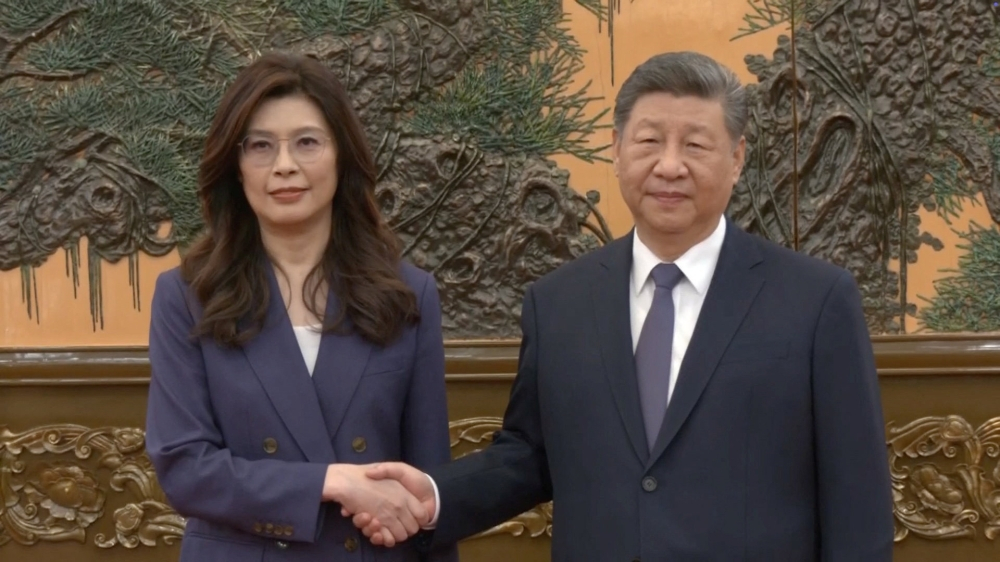
Speaking during a high-level meeting in Beijing’s Great Hall of the People, Xi emphasized that peace in the Taiwan Strait is fragile and must be protected. However, he placed the blame for instability squarely on pro-independence movements in Taiwan, calling them the primary threat to regional harmony.
The meeting was held with Cheng Li-wun, chairwoman of Taiwan’s major opposition party, the Kuomintang (KMT). Her visit to China has been framed as a “peace mission,” aimed at easing tensions during a period marked by increased military activity and political friction.
Xi’s tone blended both warning and outreach. He described people on both sides of the Taiwan Strait as part of one family, stressing shared cultural and historical ties. At the same time, he reiterated China’s long-standing position that Taiwan is part of “one China,” underscoring Beijing’s commitment to eventual reunification.
He also called for stronger cooperation between the KMT and the Chinese Communist Party, suggesting that renewed trust and dialogue could help shape a more stable and unified future.
Meanwhile, Taiwan’s current leadership, under President Lai Ching-te, continues to face pressure from Beijing. China has refused direct engagement with Lai, labeling him a separatist. In response, Taiwan’s ruling party has urged opposition figures like Cheng to push back against China’s growing military and political threats.
Back in Taipei, criticism has emerged over the timing of Cheng’s visit. Hsu Kuo-yung, a senior member of the ruling party, questioned whether the opposition was sending the wrong signal by engaging Beijing while delaying key defence decisions at home.
The roots of this complex relationship trace back to the end of the Chinese Civil War in 1949, when the KMT government retreated to Taiwan after losing to the communists led by Mao Zedong. Since then, both sides have operated as separate governments, without a formal peace agreement, each maintaining its own political system and identity.
During the meeting, Cheng emphasized the importance of mutual respect and cooperation. She expressed hope for a future where dialogue replaces confrontation, even extending an invitation for Xi to visit Taiwan someday. Her message focused on building sustainable communication channels and reducing the risk of conflict in the region.
The broader international dimension adds another layer of complexity. The United States remains Taiwan’s most significant supporter, providing military assistance and backing its defence initiatives, despite not having formal diplomatic relations. China has repeatedly urged Washington to stop supplying arms to Taiwan, viewing such actions as interference.
At its core, this situation reflects a delicate balancing act between power, identity, and diplomacy. While leaders exchange firm words and strategic signals, millions of ordinary people on both sides simply hope for stability, opportunity, and peace. The challenge lies in turning political rhetoric into meaningful dialogue—before tensions escalate beyond control.