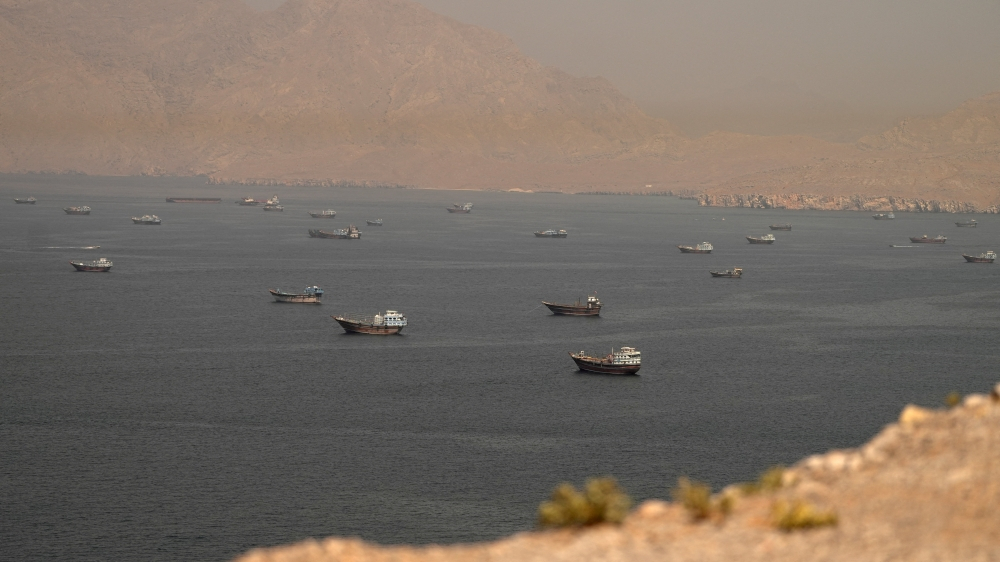
Global concerns over maritime security have resurfaced after the United Nations’ International Maritime Organization (IMO) temporarily suspended its escort operations through the Strait of Hormuz following an attack on a commercial vessel near Oman.
Taiwan-based shipping company Evergreen Marine confirmed that its Singapore-flagged vessel, Ever Lovely, was struck by an “unknown object” while sailing through waters near Oman on a route recommended by the United Kingdom Maritime Trade Operations (UKMTO).
Earlier, maritime authorities reported that a vessel had been hit by a projectile just hours after Iran issued a warning advising ships not to use routes that had not been approved by Tehran.
According to Reuters, two US officials alleged that Iran was responsible for the attack. Meanwhile, Iran’s Persian Gulf Strait Authority stated that ships travelling outside designated routes would not be guaranteed safe passage.
The authority emphasized that any consequences resulting from using unauthorized routes would be the responsibility of vessel owners, operators, and commanders.
Evergreen Marine said the impact damaged the starboard side of the vessel, including windows on the bridge. Despite the incident, the company confirmed that all crew members, cargo, and the ship itself remained safe.
“The crew, vessel, and cargo are all safe,” Evergreen said in its official statement, adding that the ship had successfully exited the Strait of Hormuz.
A security source suggested that the vessel may have been targeted by a drone, although the exact circumstances remain under investigation.
The incident comes at a particularly sensitive time. The International Maritime Organization had been coordinating efforts to assist hundreds of stranded ships and thousands of seafarers trapped in the region since the conflict began on February 28.
Following the latest attack, IMO Secretary-General Arsenio Dominguez announced that the organization would temporarily pause its evacuation initiative to reassess whether sufficient safety guarantees remained in place for ships operating in the area.
The vessel involved in the suspected attack was not part of the IMO’s evacuation program, which had recently introduced voluntary transit routes through Iranian and Omani waters under US oversight.
The Strait of Hormuz remains one of the world’s most strategically important waterways, carrying nearly one-fifth of global daily oil and liquefied natural gas shipments before the conflict disrupted normal operations.
Since the outbreak of hostilities, Iran has effectively exercised significant control over traffic passing through the narrow passage, creating uncertainty across global energy markets and interrupting oil transportation.
Despite the security concerns, there were signs of gradual recovery in energy exports. Shipping data indicated that Saudi Aramco resumed oil loading activities at the Ras Tanura terminal after nearly four months of reduced operations.
Data from shipping analytics firm LSEG showed that two Very Large Crude Carriers (VLCCs) operated by Saudi shipping company Bahri were loading crude oil at Ras Tanura, while another tanker waited nearby. Each vessel is capable of carrying approximately two million barrels of oil.
Elsewhere, South Korean President Lee Jae Myung announced that three South Korean vessels would leave the Strait of Hormuz over the weekend. The country’s Oceans Ministry also reported that eight additional South Korean ships had already exited the region.
Meanwhile, diplomatic tensions continue to persist. US Secretary of State Marco Rubio warned that any attempt to threaten or obstruct shipping through the Strait of Hormuz could trigger serious consequences.
Iran’s Revolutionary Guards, however, reiterated that safe passage would only be permitted through routes designated by Iran and warned that action could be taken against vessels failing to comply. British maritime security firm Ambrey reported that two Panama-flagged ships were ordered to alter their course on Thursday.
The ongoing conflict is also becoming a political issue in the United States ahead of November’s midterm elections. A Reuters/Ipsos poll found that only one in four Americans believe the war has been worth its cost.
Although preliminary ceasefire discussions have raised hopes of de-escalation, significant disagreements remain over financial arrangements for Iran, nuclear inspections, the future governance of the Strait of Hormuz, and broader regional conflicts, including Israel’s parallel war in Lebanon.
The current framework agreement provides for 60 days of negotiations aimed at resolving these deeply complex issues. However, the latest maritime attack serves as a reminder that the situation remains fragile, and the stability of one of the world’s most important shipping corridors continues to hang in the balance.