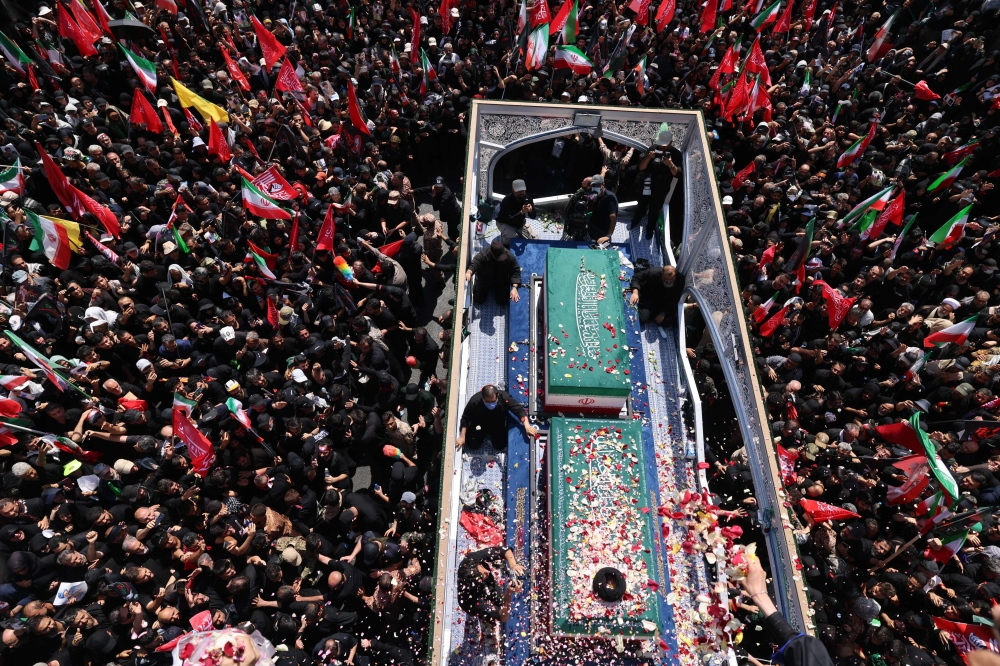
The streets of Tehran were filled with millions of mourners today as Iran held one of the largest funeral processions in its modern history to honor its late Supreme Leader, Ali Khamenei. The overwhelming turnout reflected the significance of the moment, with crowds stretching across major roads and public squares throughout the capital.
Although officials have not yet released an official attendance figure, images from across Tehran showed an extraordinary sea of people gathering to pay their final respects. Many observers believe the turnout could rival the historic funeral of Ayatollah Ruhollah Khomeini in 1989, which drew an estimated 10 million mourners.
The farewell ceremony comes after five weeks of military conflict involving Iran, the United States, and Israel. As the nation mourns its longtime leader, the event has also become a powerful display of unity and resilience during a period of uncertainty.
Ali Khamenei’s body had remained at Tehran’s Grand Mosalla religious complex for two days, allowing thousands to visit before today’s procession. As the funeral cortege moved through the city, flower petals covered the coffin while mourners lined the streets, waving Iranian flags and chanting prayers.
Authorities took extensive precautions to prevent overcrowding and ensure public safety. The measures were shaped by memories of the chaotic funeral of Ayatollah Khomeini nearly four decades ago, when crowd surges resulted in numerous deaths and thousands of injuries.
Many attendees described today’s gathering as deeply emotional.
One mourner, Gholamreza Khanbabaei, who had also attended Khomeini’s funeral in 1989, said the atmosphere felt remarkably similar.
“If I compare today’s ceremony with that one, there is very little difference. But the people seem even more passionate this time,” he said.
As the procession continued, Tehran’s airspace remained closed while security forces monitored the city. Trucks sprayed water into the crowds to help people cope with the intense summer heat, while volunteers distributed flags, bottled water, and portraits of both Ali Khamenei and his son, Mojtaba Khamenei.
Some mourners carried flags representing Iran, while others displayed banners associated with Hezbollah and red flags traditionally symbolizing calls for justice and revenge. State media also reported demonstrations in Imam Hussein Square, where an effigy of former U.S. President Donald Trump was displayed by participants.
Former Iranian President Mahmoud Ahmadinejad was also seen attending the funeral procession alongside senior political and military figures.
One of the most closely watched aspects of the ceremonies has been the continued absence of Mojtaba Khamenei. Although he was named Supreme Leader shortly after his father’s death, he has not appeared publicly since assuming the position.
Iranian officials have stated that Mojtaba was injured during the airstrikes that killed his father, but no official details have been released regarding the extent of his injuries.
Meanwhile, three of Ali Khamenei’s other sons made a rare public appearance during Sunday’s funeral ceremonies, drawing further attention to Mojtaba’s absence.
Senior military officials also attended the event, including Revolutionary Guards Commander Ahmad Vahidi and Quds Force leader Esmail Qaani, both making notable public appearances following the recent conflict.
The funeral procession covers nearly 20 kilometers across Tehran and will continue with additional memorial ceremonies in the religious city of Qom before extending to the Iraqi holy cities of Najaf and Karbala. Ali Khamenei is expected to be laid to rest later this week in his hometown of Mashhad.
Beyond mourning, the funeral has become a significant political moment for Iran. Government leaders view the massive public gathering as a demonstration of national solidarity following months of domestic unrest and international confrontation.
Despite a temporary ceasefire currently holding between Iran and its adversaries, tensions remain high across the region. Iranian officials have repeatedly warned they are prepared to respond to any future military action, while many mourners echoed calls for retaliation during today’s ceremonies.
Delegations from groups allied with Tehran, including Hamas and Hezbollah, were also present, underscoring Iran’s longstanding regional alliances.
As millions continue to gather to honor Ali Khamenei, the world is closely watching what comes next. The funeral not only marks the end of one of the Middle East’s most influential political eras but also raises important questions about Iran’s future leadership, regional strategy, and its relationship with the international community.