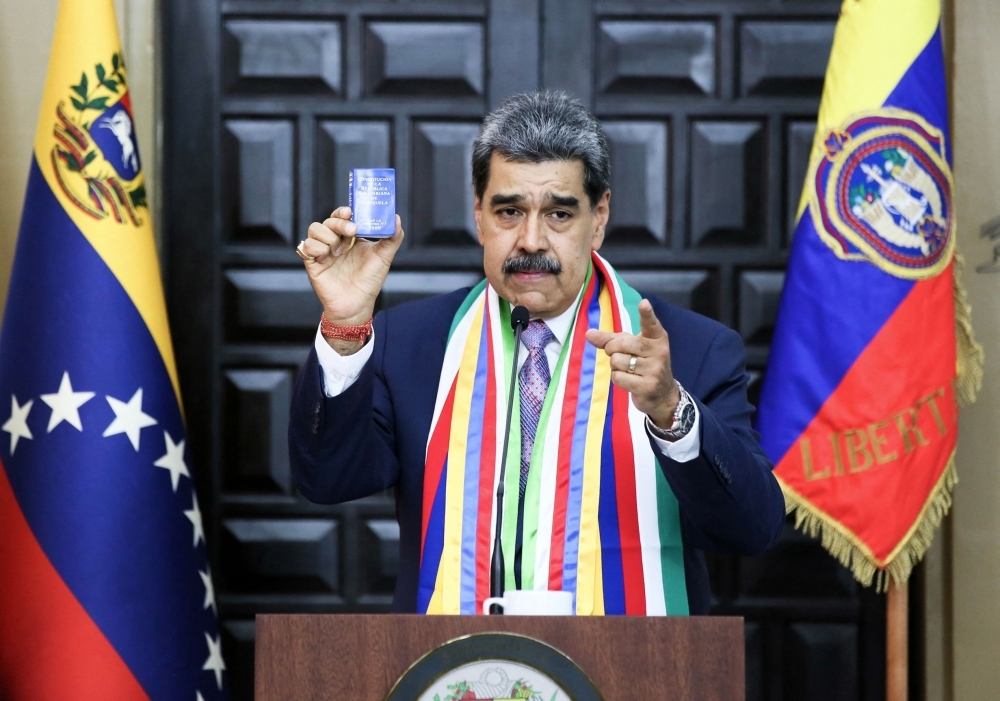
Venezuela has struck a defiant tone in response to US President Donald Trump’s latest warning of a sweeping oil blockade, insisting that its crude exports continue without disruption.
The statement came a day after Trump announced what he described as a “total and complete blockade” of all sanctioned oil tankers entering or leaving Venezuela, escalating months of military and economic pressure against President Nicolas Maduro’s government.
Despite the strong language from Washington, Venezuelan authorities said operations remain steady. State oil giant Petróleos de Venezuela (PDVSA) confirmed that crude oil and petroleum byproduct exports are moving as usual, with tankers continuing their routes under what the company described as full security.
“Export operations for crude and byproducts continue normally. Oil tankers linked to PDVSA operations continue to sail with full security,” PDVSA said in an official statement.
Trump, meanwhile, doubled down on his warning, pointing to the heavy US military presence in the Caribbean, including the deployment of a US aircraft carrier. He claimed Venezuela was “completely surrounded” and said US forces would prevent any unauthorized tanker movements. The former president also repeated long-standing accusations that Venezuela had “taken all of our oil,” a reference widely interpreted as criticism of the country’s past nationalization of its energy sector.
Amid rising tensions, President Maduro held a phone conversation with UN Secretary-General António Guterres, warning of what he called an “escalation of threats” from the United States and their potential impact on regional peace. Guterres urged both sides to exercise restraint and work toward de-escalation to preserve stability in the region.
Venezuela’s military also responded firmly, stating it was “not intimidated” by the threats. Given that oil exports remain the backbone of Venezuela’s struggling economy, the blockade threat carries significant weight, but officials appear determined to project calm and control.
International reactions have begun to surface as well. China, Venezuela’s main oil buyer, voiced support for Caracas, with Beijing’s foreign minister condemning what he called unilateral pressure and reaffirming China’s stance on national sovereignty and dignity.
The standoff follows a series of US actions in the Caribbean, including the recent seizure of the oil tanker M/T Skipper in a dramatic operation involving US forces. Washington has framed its expanded military presence as part of anti-narcotics efforts, though Caracas argues these operations are a pretext for undermining Maduro’s government and seizing control of Venezuelan oil resources.
Analysts warn that a full blockade could severely impact Venezuela’s already fragile economy. The country has been under a US oil embargo since 2019, forcing it to sell crude at discounted prices, largely to Asian markets. Oil production has dropped sharply, from more than three million barrels per day in the early 2000s to around one million today.
Capital Economics noted that a blockade could cut off a crucial economic lifeline in the short term, while the longer-term impact would depend on how far Washington is willing to push and how the confrontation ultimately unfolds.
At the human level, this dispute is about more than geopolitics and oil shipments. For millions of Venezuelans already grappling with inflation, shortages, and economic uncertainty, any disruption to oil revenues threatens daily survival. As world powers trade warnings and statements, ordinary people remain caught in the middle, hoping diplomacy prevails over escalation and that stability, not sanctions, defines the next chapter of their future.