
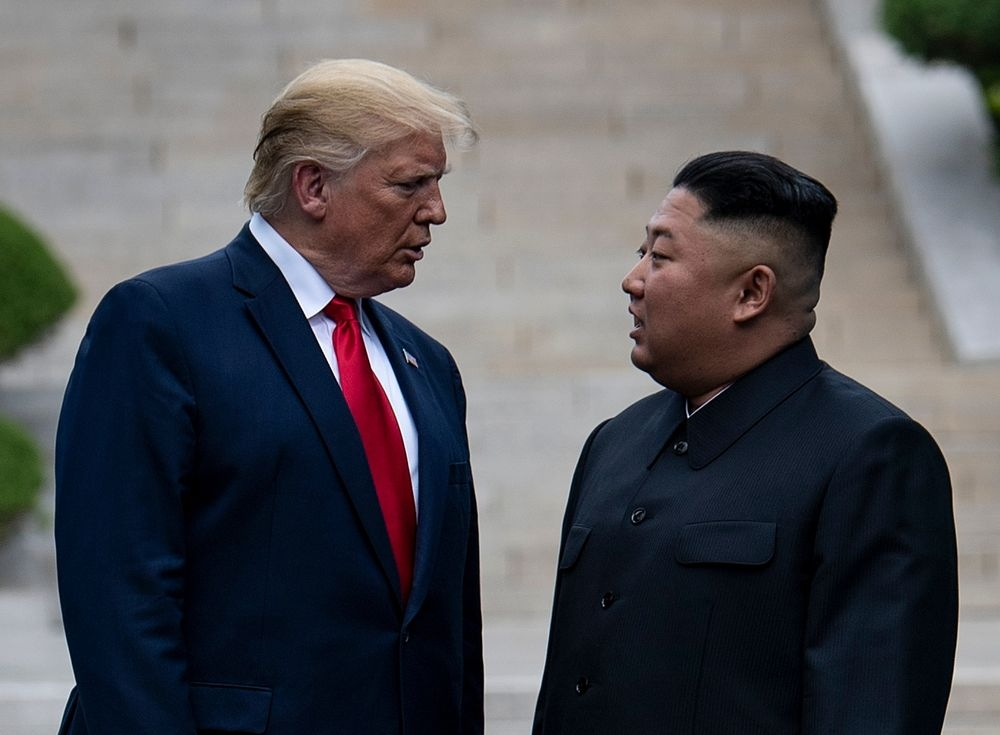
The possibility of a new meeting between US President Donald Trump and North Korean leader Kim Jong Un is looking increasingly uncertain as Pyongyang strengthens its strategic relationships with Russia and China. With world leaders preparing to gather in Shenzhen for the November APEC summit, speculation about a possible encounter has grown, but analysts believe the political conditions may no longer favour a breakthrough.
The contrast with 2019 is striking. After a summit with Trump collapsed in Hanoi, Kim faced a long 60-hour train journey home without an agreement. Today, the situation appears different, with Trump expressing interest in meeting Kim while North Korea has yet to show a clear willingness to engage.
During his recent remarks, Trump said he might meet Kim during his upcoming Asian tour, describing the prospect as exciting. However, he later expressed uncertainty about whether anyone was seeking such a meeting, while maintaining that his relationship with the North Korean leader remained good.
A meeting between the two leaders would attract international attention, but the diplomatic landscape has changed considerably since their previous encounters. Analysts suggest Trump may be looking for a foreign policy achievement as the war involving Iran continues, while Kim may see fewer immediate benefits in returning to negotiations with Washington.
North Korea’s growing partnership with Russia has strengthened Kim’s position. Pyongyang’s reported supply of troops and weapons in support of Moscow’s war against Ukraine has helped deepen ties with Russian President Vladimir Putin. In return, North Korea has gained valuable political and economic support, potentially reducing the impact of international sanctions imposed over its nuclear programme.
Economic developments have also contributed to Pyongyang’s confidence. South Korea’s central bank estimated that North Korea’s economy grew by more than three per cent for a third consecutive year in 2025, attributing much of the expansion to increased economic cooperation with Russia. China, meanwhile, remains North Korea’s most important traditional ally and a major source of diplomatic and economic support.
These developments have led some experts to question whether Kim has sufficient motivation to pursue another high-profile meeting with Trump. Lim Eul-chul, a professor at Kyungnam University’s Institute for Far Eastern Studies, told AFP that he saw almost no possibility of a meeting, arguing that maintaining the current situation was Kim’s best option.
South Korea’s ambassador to Washington, Kang Kyung-wha, also indicated that concrete progress toward a possible Trump-Kim meeting had not been achieved.
Previous summits delivered little progress on denuclearisation
During Trump’s first presidential term, he met Kim three times in an extraordinary diplomatic effort to reach an agreement on North Korea’s nuclear weapons programme. Trump once famously described their relationship by saying they were “in love,” but the personal rapport did not translate into a lasting denuclearisation agreement.
Since those meetings, North Korea has continued to expand its weapons capabilities, making negotiations more complicated. South Korean President Lee Jae Myung, who has repeatedly offered dialogue without preconditions, suggested in September that Washington could consider seeking a freeze on North Korea’s nuclear programme rather than demanding its immediate elimination, potentially in exchange for sanctions relief.
Supporters of this approach may see it as a practical way to reduce nuclear risks. Critics, however, warn that it could effectively acknowledge North Korea as a nuclear-armed state while allowing Kim’s government to obtain economic concessions without dismantling its arsenal.
China’s position has also drawn attention. Kim hosted Chinese President Xi Jinping in Pyongyang in June, following Xi’s separate high-level meetings in Beijing with Trump and Putin. Neither Pyongyang nor Beijing referred to North Korea’s denuclearisation in their official statements following the meeting, an omission that some analysts interpreted as a sign of changing diplomatic priorities.
Hong Min, a senior researcher at the Korea Institute for National Unification, told AFP that the growing division between the United States and Japan on one side and North Korea, China and Russia on the other was creating significant strategic opportunities for Pyongyang.
North Korea shows little interest in abandoning its nuclear arsenal
North Korean officials have repeatedly rejected the prospect of giving up their nuclear weapons. In September, Kim’s powerful sister, Kim Yo Jong, described the country’s nuclear status as absolute and dismissed those who continued to expect denuclearisation.
For international policymakers, the central question may therefore be changing. Rather than focusing exclusively on whether North Korea will abandon its nuclear arsenal, Washington may eventually have to decide whether it is prepared to negotiate on the assumption that the weapons programme will remain in place.
Vladimir Tikhonov, a professor of Korean Studies at the University of Oslo, told AFP that the possibility of such a policy shift was substantial. A change of this kind would represent a major adjustment in US policy, with implications for regional security, sanctions and relations with key allies.
China also has strategic interests at stake. Its influence partly depends on its position as an important intermediary in relations between Washington and Pyongyang. A direct agreement between Trump and Kim that excluded Beijing from the process could weaken China’s ability to influence both sides.
Yang Moo-jin, former president of the University of North Korean Studies, suggested that dialogue could still take place with the understanding of Putin and Xi. However, he argued that North Korea’s existing benefits from its relationship with Russia made a sudden shift toward uncertain negotiations with Washington difficult to imagine.
A diplomatic breakthrough remains uncertain
For now, North Korea appears to have more room to manoeuvre than it did during Trump’s first term. Stronger ties with Moscow, continued support from Beijing and the development of its nuclear capabilities have changed the incentives surrounding any potential summit.
For Trump, a meeting could offer an opportunity to revive diplomacy and demonstrate progress on one of the world’s most difficult security challenges. For Kim, however, the risks and rewards may look very different from those of 2018 and 2019.
The prospect of renewed dialogue has not disappeared entirely, but a meeting alone would not guarantee meaningful progress. Any lasting breakthrough would require both sides to address the fundamental disagreements over nuclear weapons, sanctions and security guarantees.
As the APEC summit approaches, the uncertainty surrounding a possible Trump-Kim encounter highlights a broader reality: international diplomacy depends not only on personal relationships but also on changing strategic interests. With North Korea gaining support from Russia and China, convincing Kim to return to serious negotiations may prove far more difficult than it once appeared.
Source: Agence France-Presse (AFP)


